

Ever downed a flute of Champagne and wondered why it got you drunk faster than usual? You’re not alone! You're not imagining that sparkling wine can sometimes seem to “hit harder.”
After a few glasses, you may actually feel the alcohol hitting you sooner than expected and it has a scientific reason. Champagne has the ability to make alcohol hit faster but it isn’t as simple as saying that every glass of Champagne will make you more intoxicated than the same amount of still wine. Here's what is actually happening.
First, let's clear up one of the biggest misconceptions: Champagne is not necessarily stronger than wine.
Champagne is a type of sparkling wine produced in the Champagne region of France under specific production rules. Its alcohol content roughly hovers around 12% ABV, almost the same as many table wines.
Still wines can also range considerably, from around 10% to 15% ABV or more depending on the style. So, does Champagne have more alcohol than wine? Not really.
Also Read: Sparkling Wine Vs Champagne: What's The Difference?
So the real question is: does champagne get you drunk faster? The answer might lie in its composition.
The biggest difference distinguishing Champagne and still wine is that the former contains bubbles.
Champagne contains dissolved carbon dioxide bubbles, resulting in its distinct fizz. When you drink it, that carbonation plays a strong role in determining how quickly alcohol moves through your system.
Many studies show that carbonated alcoholic drinks can lead to faster alcohol absorption in some circumstances. One study showed that drinking vodka mixed with carbonated drinks spikes your blood alcohol content at a higher level than just vodka. But carbonation isn't the only factor.
Also Read: 5 Luxury Champagne Brands To Try In Delhi
Potentially, yes.
When you drink a carbonated alcoholic beverage, the carbon dioxide can increase pressure in the stomach and may encourage the stomach contents to be pushed faster into the small intestine.
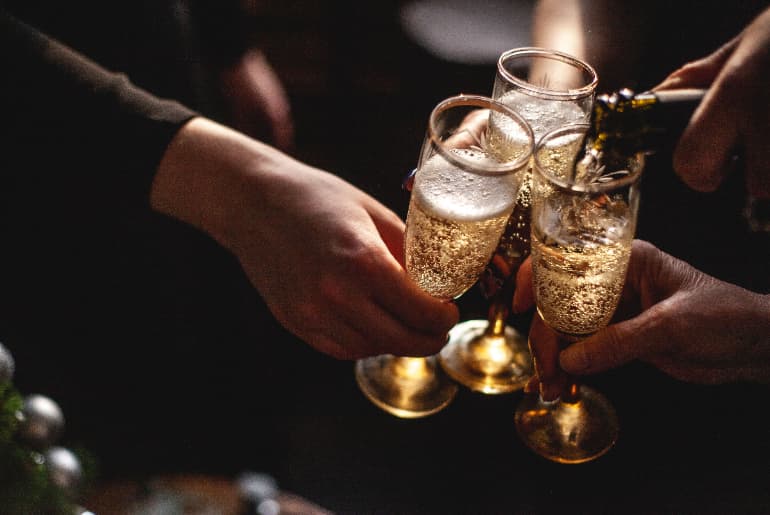
There is a leading hypothesis that states why carbonated alcoholic beverages make you ‘unsobered’ faster. Alcohol primarily gets into the blood by seeping through the lining of the small intestine. Alcohol is seeped into the bloodstream even through the stomach but more slowly. Carbonated drinks, due to the carbon dioxide bubbles in them, As gas pressure pushes the alcohol into the small intestine sooner, the body absorbs alcohol much faster here than in the stomach. This is what results in a quicker rise in blood alcohol levels.
Sparkling wine, including Champagne isn’t necessarily ‘stronger’ but its potency can depend on several factors as mentioned below:
If you enjoy Champagne but don’t want it to hit you hard the next day, here are a few simple habits that will help you out.

Also Read: Why Champagne Pops: The Physics Of Pressure In A Bottle
So, does Champagne get you drunk faster? Sometimes, yes – but it doesn’t mean that Champagne is automatically stronger than other kinds of liquor.
Champagne generally has a similar alcohol concentration to many still wines. But it is carbonation that distinguishes it from still wine. Carbonation is largely responsible for the phenomenon that causes a rapid spike in the alcohol content in your blood level.