
Before it was a single malt, Godawan was a bird. A bird that is quietly disappearing and reminding us of what happens when we take more than we give back. So it’s no coincidence that an award-winning Indian single malt that is determined to give back more than what it takes chooses to carry this name: ‘Godawan’.
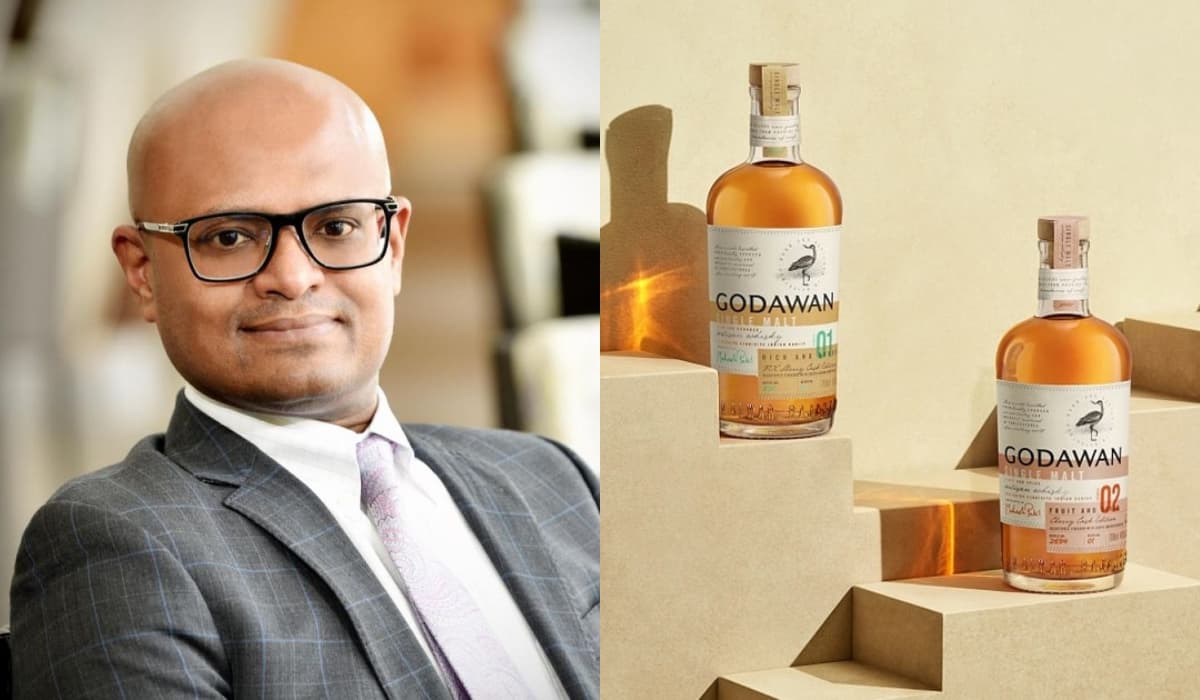
Godawan Artisanal Single Malt Whisky was never meant to be just another luxury whisky. It carries a vision that is rooted in environment-conscious practices, innovation, and the resilience to forge an unconventional path. At the heart of this audacious vision is Vikram Damodaran, Chief Innovation Officer at Diageo India and Co-Founder of Godawan Artisanal Single Malt Whisky.
When unsobered spoke to him, it felt less like an interview and more like being walked through a philosophy. One rooted in intention and a belief that beauty, when tended to carefully, often emerges from places least expected.
When Godawan Artisanal Single Malt Whisky began its journey around six and a half years ago, the Indian alcohol landscape was clear-cut. Whisky dominated nearly 95 percent of the market, while other categories like gin, vodka, etc made up the remaining sliver. Within whisky itself, single malts reigned supreme.
“If we had to do something disruptive,” Damodaran explains, “it had to be in a category that already commanded lateral appreciation.” In simpler terms, if you wanted people to take notice, you had to speak in a language that they understood and appreciated. Single malt whisky was that language.
But the goal was not to create just another single malt – it was to differentiate it from the rest. Godawan Artisanal Single Malt Whisky had to stand for something larger than taste alone. It had to find a narrative strong enough to sail in a saturated sea of whisky stories.
Perhaps the boldest decision then came in terms of the whisky’s geographics. While most single malts proudly lean on imagery of lush pastures and abundant water, typically suitable in Scotland and Japan, Godawan deliberately rejected those associations.
People, Damodaran notes, instinctively link single malt whisky with Scotland or Japan. But Godawan went in the opposite direction and chose the unconventional.
They chose Alwar, Rajasthan.
A land, mostly barren, defined by heat, aridity, and scarcity. A place that seemingly did not tick any of the boxes for conventional whisky production. And yet, it was precisely what the team looked for – ‘creating beauty out of scarcity’.
Making whisky in itself is difficult. Making it in Alwar then adds an entirely new layer of complexity.
The first challenge was access to water. Despite being the largest user of groundwater in the world, India has access only to about 4% of the world’s water resources. Whisky, notoriously water-intensive, requires roughly 20 liters of water to produce a single liter of spirit. So finding clean, usable water resources without burdening the local ecosystem became a foundational hurdle, as mentioned by Damodaran.
Then came ‘time in the barrel’. In Scotland, where average temperatures hover between 2 and 4 degrees Celsius, whisky loses only about 2 percent of its volume annually to evaporation in a process named the ‘angel’s share.’ In Alwar, with extreme temperature fluctuations, that loss jumps dramatically to around 22 percent every year.
The third challenge was belief. Convincing people that a world-class single malt could emerge out of a land so scarce required patience, persistence, and a heavy dose of optimism.
To tackle these challenges, Godawan had to respond in a precise way and engineer its whisky.
The team uses barley sourced from a specific cluster of farms along India’s northwestern frontier, chosen for a variety that requires less water.
They also use Rajasthan’s climate, often seen as a barrier, to their advantage. The intense heat, persistent through the majority of the year, amplifies flavor extraction from the cask. On the other hand, the cooler months allow the whisky to settle and harmonize. Aging happens across two temperature ranges, something few regions can offer naturally.
Distillation happens through a slow trickle process in traditional copper pot stills. Here, science and poetry intertwine. Allowing the distillate to rest longer in the pot still enables accelerated sulfur removal without taking away the liquid’s intrinsic character. To make the explanation more approachable, Damodaran was kind enough to offer a striking analogy:
Visit old monuments in Paris, and you will see a patina on their surfaces, a natural greenish sulfur coating formed over time. Open the roof of a pot still, and you will find the same patina. Godawan uses this phenomenon to its advantage, letting time and temperature quietly refine the spirit.
Also, the entire whisky manufacturing process has been fine-tuned to minimize water usage at every step.
Godawan takes its name from the Great Indian Bustard, a critically endangered bird that was once close to being declared India’s national bird. It lost the crown to the majestic peacock, but more importantly, its numbers began to dwindle.
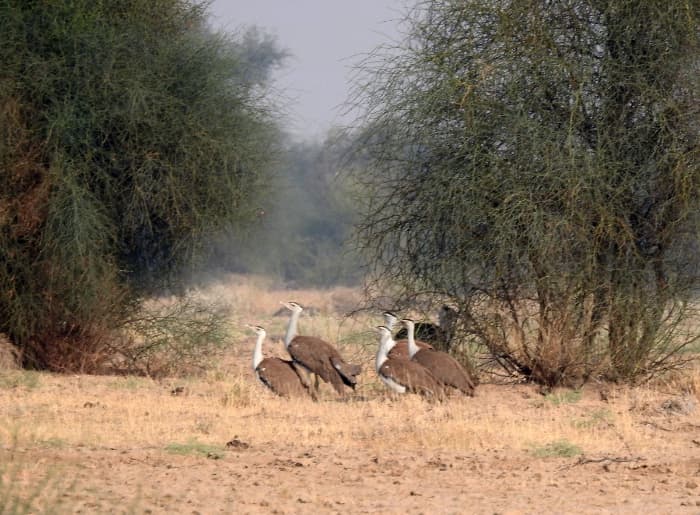
From the outset, Godawan committed to investing in the conservation of this majestic species. Today, the brand, through its conscious conservation efforts, has managed to increase the Great Indian Bustard from 96 to 173, a tangible outcome that Damodaran speaks about with quiet pride.
The whisky, in a sense, honors the spirit of the bird: resilient and deeply tied to the land.
Also Read: 130 Crore Acquisition: Diageo India Acquires Indian Craft Gin Maker NAO Spirits!
Godawan takes an unconventional turn with botanical finishing, usually unheard of in whisky-making. The team uses cask steeping techniques involving rasna and jatamansi, two traditional Indian botanicals. These botanicals lend a cooling finish, counterbalancing the intensity created by accelerated aging.
Without this step, Damodaran explains that without this whisky, the whisky could carry a mild burn. Botanical finishing helps ‘soften’ the edges and adds a cooling, soothing elegance without tampering with the flavor and intensity.
One of Godawan’s most distinctive achievements lies in its structure, an aspect that Damodaran is especially proud of! Unlike most whiskies that rely on multiple base spirits to achieve varied profiles, Godawan works with a single “mother spirit.”
From this one origin emerge multiple sensory expressions.
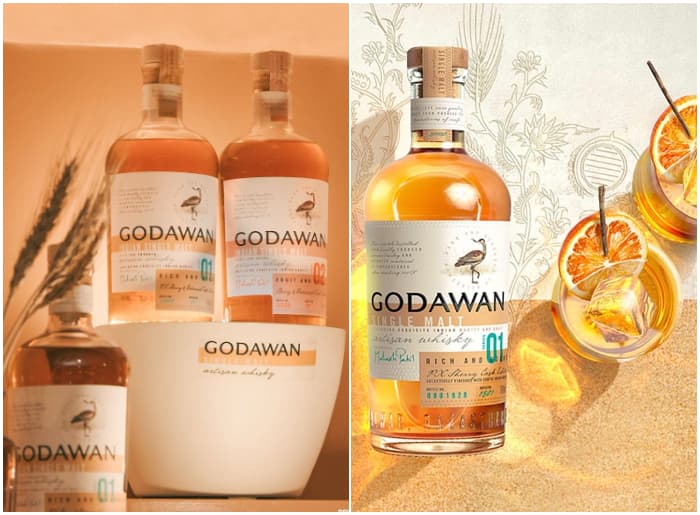
Godawan 01 is rich and grounded. Godawan 02 leans into fruit and spice. Remarkably, both expressions together span all four major quadrants of the whisky flavor wheel: rich and grounded, fruit and spice, light and floral, and bodied smoke.
No other whisky, Damodaran notes, achieves this feat from a single-mother whisky. The other two expressions are expected to launch sometime, so keep your eyes on them!
From day one, Godawan operated on a simple principle: give back more than you take.
Parallel to making whisky, efforts were launched to renew the Ruparel River, located just 10 kilometers from the Alwar plant. Once depleted, the river now flows through greener surroundings, supporting local livelihoods and ecosystems.
The distillery employs workers from nearby villages, invests in accessible restrooms for women, and consciously contributes to community upkeep.
Godawan is also the only distillery in Asia to achieve Alliance for Water Stewardship certification, first at gold level and now at platinum. In a water-stressed region, this is not just a badge of honor; it is the sign of a responsibility fulfilled!
Also Read: 5 Whisky Cocktails That Fit the Indian Winter Christmas Mood Perfectly
When asked about a defining moment that stood out the most for Mr. Vikram Damodaran, he shared with us not one but three such heartwarming moments.
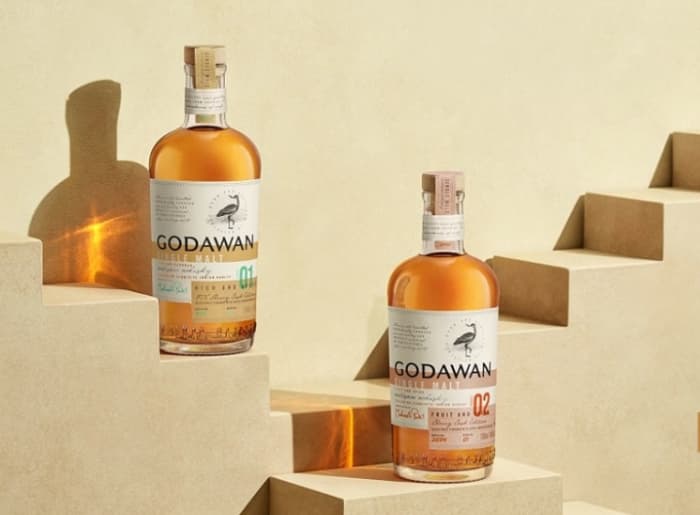
The first was the first day at the distillery, when people could clearly differentiate between Godawan 01 and 02. That was a moment that stayed with him as he saw efforts finally translate into distinguishable, tangible outcomes.
The second was the launch at Jaipur’s Rajmahal Palace RAAS, grounding the whisky in its home state.
And the third moment that has stayed with him was the launch of the first bottle of Godawan 173. Unveiled in style at The Savoy in London during London Fashion Week 2025, the launch grabbed global eyeballs and positioned the Indian single malt on a global stage.
As the conversation steered from memories and moments to whisky myths, Damodaran shared a few misconceptions about this elegant spirit.
The first: everyone thinks they are an expert, yet no one truly is! Whisky is meant to be discovered, not dictated.
The second: there is a “right” way to drink it. There isn’t. “Have it the way you love it,” he says with a simple smile.
The third: whisky is mass. It isn’t. Whether IMFL (Indian made foreign liquor) or international, art exists in every bottle. And as consumers, we must appreciate all kinds of whisky.
Damodaran’s own ritual is refreshingly unpretentious. He is a man who loves experimenting, but when trying a new whisky for the first time, he has it neat first. After that, he loves experimenting with water and ice.
When asked what foods go well with Godawan’s expressions, he promptly replied: “Godawan 01 is nutty and full-bodied and pairs beautifully with desserts. Godawan 02, delicate and slightly sweet, shines alongside kebabs, whether vegetarian or non-vegetarian.”
He gently let out a laugh as we asked this, also letting us know how he too gave this question some thought a while back.
He imagines it as someone gentle, soulful, and giving. A presence that brings communities together. Following up with that, we asked him which personality from a bygone era would he share the whisky with, and answered “Winston Churchill.”
Three words to describe Godawan? We further asked.
“Flavorful. Authentic. Purposeful.’ And we couldn’t agree more!
Godawan’s future looks strong because the foundation is strong, asserts Damodaran. But success to him is also counted in the rising bird numbers, revived water sources, and communities that are thriving alongside the distillery. From 96 to 173, the rise in Godawan birds’ numbers mirrors the ambition of another successful conservation movement in India – Project Tiger.
In a world chasing abundance, Godawan chose the unconventional and found beauty in scarcity. A tale of legacy, innovation, and resilience that will definitely inspire future whisky makers and consumers from all over the world.