

.jpg&w=3840&q=75)
Meghalaya is famous for its hills, living root bridges, and myriad indigenous cultures. It's also known for its rice beer. This beer is made with locally grown rice, natural fermentation starters, and traditional techniques passed down for generations. It's an important part of life in the state and features heavily in both daily life and various festivals.
Unlike commercial beer, Meghalaya's traditional rice beer is deeply rooted in the indigenous cultures of the various communities that inhabit the state. The Garos refer to their fermented rice drink as Chubitchi or Bitchi, while the Khasis and Pnar/Jaintia call it Kiad (also spelled Kyat). The methods of production vary, but the drink's cultural significance is essentially the same in all cases.
Meghalaya's traditional rice beer is an alcoholic drink made by fermenting cooked rice with a local starter culture. It's not like regular beer, which is typically brewed with malted barley and hops. Traditional rice beer is made using a starter culture that is itself a mixture of rice and various plant materials.
Chubitchi is one of the better-documented traditional drinks of Garo. It's made at home and has traditionally been served at festivals, weddings, and other community functions. Kiad is the drink of the Jaintia Hills. It's sometimes described as rice wine, though the ingredients and methods of preparation are very much rooted in tradition.
Rice is the base of these traditional drinks, the type of rice used varies from community to community and household to household, some use glutinous rice while others use non-glutinous rice, and some use locally grown varieties of sticky rice. For the Garos, rice is Merong and sticky rice is Minil. The type of rice used will affect the texture and flavor of the drink.
Another key component is the fermentation starter as the Garo traditionally use Wanti, while the Jaintia use Thiat. The starter can be ground rice mixed with various local plants and herbs. Research into the preparation of Chubitchi has identified jackfruit leaves, guava leaves, ferns, and chilies as ingredients. However, the recipes are not uniform and these ingredients should not be regarded as applicable to all of Meghalaya.
.jpg&w=1920&q=75)
The process typically starts with cooking and cooling rice (sometimes on banana leaves). A powdered fermentation starter is then added to the rice. The mixture is transferred into an earthen pot, where microbes in the starter convert the starch in the rice into fermentable sugars and ultimately alcohol.
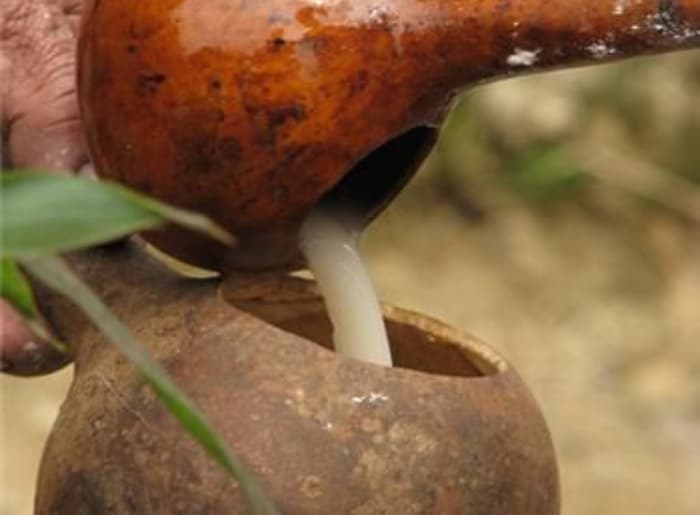
In documented Garo preparations, the vessel (a Dikka) contains a cylindrical bamboo strainer (a Janti). The vessel is covered with banana leaves and left to ferment for about a week or more, depending on the season and method of preparation. The liquid ferments down into the strainer and is traditionally drawn off using a dried gourd (an Abet). It can be consumed straight or diluted with water.
Explore how women shaped ancient brewing traditions over 7,000 years ago and influenced the beer we know today.
Rice beer has been part of Meghalaya's indigenous tradition for generations. Its exact origins are unknown. The knowledge of how it's made has been passed down through oral tradition, household practices, and community traditions, rather than through any written recipe.
Historical accounts provide evidence for these long-established practices. P.R.T. Gurdon's early 20th-century ethnography, The Khasis, records the traditional Khasi rice drinks of Ka'iad Hiar and Ka'iad Um. The colonial records are outsider accounts and do not reflect the full breadth of Meghalaya's living traditions.
.jpg&w=1920&q=75)
For many communities in Meghalaya, traditional rice beer has been an integral part of hospitality, ritual, and social occasions. For the Garos, Chubitchi has long been a drink offered to guests and served at weddings, clan meetings, and all kinds of significant events. It has also served as a medium for storytelling and transmitting cultural knowledge.
Rice beer is also associated with agricultural festivals. At Wangala (the Garo harvest thanksgiving festival), there are traditional offerings and communal feasts, all part of the community's relationship with agriculture and their spiritual beliefs. In the Jaintia Hills, it is also used in traditional festival ceremonies such as Behdienkhlam. The practice varies from community to community, so it is important to understand each community's rice beer in its own context.
Curious about Vietnam's popular Saigon Beer? Explore its alcohol content, flavor, price, and what to expect before trying this Vietnamese lager.
The main difference is in the ingredients and fermentation process. Commercial beer is made from malted barley (or other grains), hops, water, and selected yeast. Meghalaya's traditional rice beer is made from cooked rice and indigenous fermentation starters, which contain natural microbes. Traditional rice beer can also vary considerably between households. Its flavor, appearance, and alcohol content depend on the rice variety, starter culture, fermentation conditions, and preparation method. Unlike standardized commercial beer, it does not necessarily have a consistent alcohol percentage. Descriptions of its taste often include mildly sweet, sour, and fermented notes, although individual preparations can differ.
.jpg&w=1920&q=75)
Traditional rice beer is still part of the cultural fabric of Meghalaya and is brewed and consumed in many households, especially during festivals and other community events. However, it is by no means uniformly brewed or consumed throughout the state. Some people still use traditional brewing methods, but with changes in lifestyle and the ready availability of commercially produced alcohol, the pattern of consumption has certainly changed.
There has also been a growing interest in indigenous food and drink traditions, which has brought increased attention to rice beer. Researchers have worked to record traditional recipes, fermentation methods, and associated indigenous knowledge. This is important, as these are not simply local alcoholic beverages. They are a reflection of indigenous agriculture, craft, and knowledge passed down through generations.
Looking for a new weekend party destination? Explore why Meghalaya is attracting Gen Z travelers with its vibrant music scene, nightlife, and unique experiences.
For this article, I explored the history, preparation, and cultural significance of traditional rice-based alcoholic beverages in Meghalaya, particularly Chubitchi of the Garo community. Drawing on academic research, historical records, and official government sources, I examined how these beverages are prepared and their importance in local festivals, rituals, and community traditions. The article aims to highlight how traditional brewing practices remain an important part of Meghalaya’s cultural heritage, extending beyond alcohol consumption to reflect generations of indigenous knowledge and customs.
Discover how Cherrapunji Gin is bringing Meghalaya to the global stage with its unique botanicals, distinctive flavors, and locally inspired craftsmanship.
Meghalaya's traditional rice beer is a fascinating window into the state's food culture and indigenous traditions. From Garo Chubitchi to Kiad and the various traditional Khasi rice beers, each is a unique blend of local ingredients, fermentation know-how, and community practice.
Although these drinks are alcoholic beverages, their significance cannot be understood through alcohol content alone. Their connections to harvest festivals, hospitality, religious practices, and oral traditions make them an important part of Meghalaya's cultural history.
.jpg&w=3840&q=100)
.jpg&w=3840&q=100)