


Wine is a versatile drink; it allows you to both drink it and cook with it. However, wines made for drinking and cooking are quite different and each has its own characteristics. If you’re thinking of cooking with wine, don’t just reach for the fancy, rich wine in your wine shelf – it’s intended for drinking. This is why we’re guiding you through what exactly is cooking wine and whether you can actually drink it!
First things first, cooking wine is the kind of wine that you can, well, cook with! Even though it sounds like an utterly simplified and vague answer, it is what the wine is all about.
You will find it in the aisles close to ingredients and condiments and not in the wine aisle of a supermarket. It contains ingredients that are meant more for stabilizing the wine and imparting flavor to the food than actually imparting flavor into the wine for direct consumption.
Also Read: Sula Launches Wine In A Can: Price, Flavors, Availability And What To Know
Cooking wine, to put it simply, is drinking wine with a lot more preservatives. It is also made with little to no regard for the grape’s flavor profile.
It includes a number of preservatives, including high levels of sulfites. These stabilize the wine but they are a topic of controversy in the wine-drinking community.
Along with high sulfite levels, cooking wines also contain high amounts of salt. This high-sodium environment is to prevent bacterial growth and impart flavor to the food. Cooking wines generally contain a more salty and earthy flavor that is easy to impart on the dish. But at the same time, these flavors aren’t the most palatable if you’re directly consuming the cooking wine.
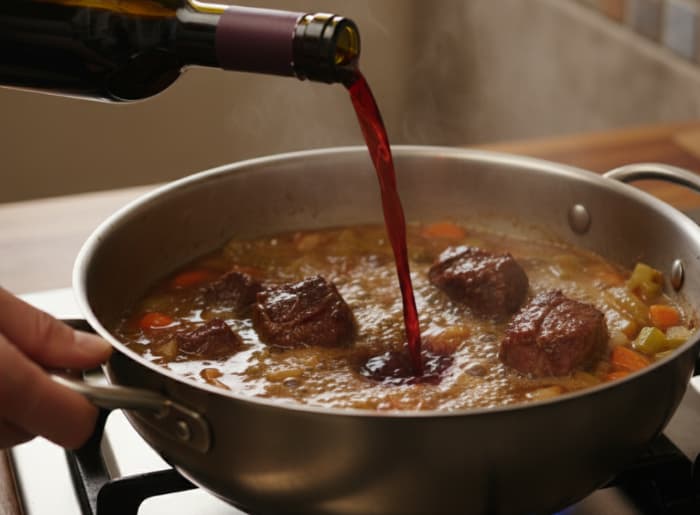
Additionally, the alcohol content in cooking wine is moderately high compared to drinking wines. Most cooking wines contain an alcohol content somewhere between 15% and 20%, higher than the usual 11% to 14% in most drinking wines. This is because a majority of the wine burns off and gets absorbed in the food in the cooking process. A cooking wine with a lower alcohol content would burn off quicker, leaving a more burnt and underwhelming taste.
Cooking wine’s main job is to act as an ingredient and impart or concentrate flavors in the dish. As the wine cooks, alcohol burns off. What remains is the flavor profile and acidity of the cooking wine. The acidity of the wine helps cut fatty ingredients, keeping meat tender and juicy. The alcohol also helps the food to release its flavor and dissolve fats.
It is also commonly used to deglaze a pan. Essentially it is added to a hot pan and all the residue, be it meat, juices, etc, is freed. These then integrate with the wine and eventually into the dish that is being cooked.
Also Read: 10 Imported Wine Brands Available In India
The question hovers more or less between ‘can’ and ‘should’.
Can you drink cooking wine? Yes, absolutely.
And should you drink cooking wine? We’d not recommend that!
At its core, it is a cooking component, so you can technically consume cooking wine. However, the taste of the wine is not particularly enjoyable. It contains little to no sugar, has high alcohol content – meaning more calories, and contains enormous amounts of salt. The result? A wine that’s best suited only for cooking and not direct consumption.
There are many health problems that can arise with the regular drinking of cooking wine. Primarily, the high sodium levels in the wine can lead to a number of health issues, including heart issues. The high alcohol content can also damage your liver and kidney functions if consumed frequently.
In the end, let cooking wine do what it does best – cook and impart great flavors! While it can be consumed, it doesn’t mean that it should be consumed. Cooking wines contain higher alcohol content, more additives, and more sodium – all of which can be harmful for your health when consumed directly.
Yes, it can. However, you’ll have to consume a lot of salty, almost unpleasant cooking wine for the ‘magic’ to happen!
If you taste or accidentally consume it, it is completely safe. However, it is not safe to consume it over prolonged periods of time as it contains a number of additives, salt, and high alcohol content.
Cooking wine contains salt because it primarily acts as a preservative. It also helps impart flavor and balance acidity.
.jpg&w=3840&q=100)
.jpg&w=3840&q=100)