
The world of spirits is filled with evocative terminology designed to signal quality, but few terms are as ubiquitous or as misunderstood – as "small batch." Whether you are browsing a local liquor store or reading a high-end bar menu, premium small batch whiskey often commands a higher price tag and a certain level of prestige.
But what exactly is the small batch whiskey meaning, and does the liquid inside the bottle actually justify the extra cost?
To get small batch whiskey explained simply: it is a whiskey produced by mixing the contents of a relatively small number of selected barrels.
Unlike "single barrel" whiskey, which comes from one solitary cask, or "standard" whiskey, which might be a blend of thousands of barrels, a small batch is a curated marriage. The goal is to create a specific flavor profile that is more consistent than a single barrel but more characterful and "boutique" than a mass-market flagship.
Interestingly, there is no legal requirement for how many barrels are in small batch whiskey. The Alcohol and Tobacco Tax and Trade Bureau (TTB) does not mandate a specific number.
Because the term is unregulated, its meaning is largely defined by the distillery’s own standards and brand transparency.
The primary difference between small batch and regular whiskey lies in the scale and the intent of the master blender.
Understanding the hierarchy of whiskey production helps clarify where small batch fits into the market.
Type | Production Method | Flavor Profile |
Single Barrel | Taken from one specific cask; never mixed. | Highly unique; varies bottle to bottle. |
Small Batch | A blend of a limited number of selected casks. | Consistent but with distinct character. |
Blended Whiskey | Often a mix of different types of whiskeys (and sometimes grain spirits). | Smooth, approachable, and mass-produced. |
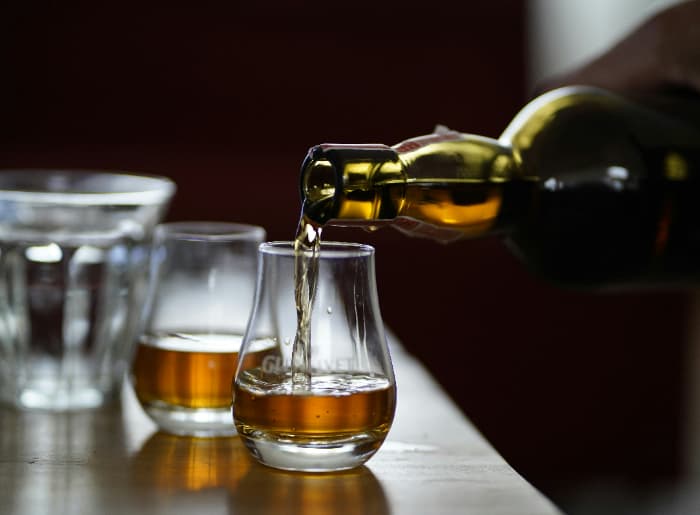
Small batch vs. single barrel whiskey: While single barrel is the ultimate expression of a "moment in time," it can be unpredictable. Small batch offers a "best of both worlds" scenario – the curated quality of premium casks with a flavor profile the distiller can actually replicate.
The small batch whiskey production process is less about a different recipe (mash bill) and more about the art of selection and maturation.
If you’ve ever wondered why small batch whiskey is expensive, it isn't just "marketing fluff." There are tangible economic reasons for the premium:
In mass production, computers and large-scale systems handle the blending. In small batch whiskey production, a Master Blender must personally taste and approve a much higher percentage of barrels to ensure they meet the "small batch" criteria. This labor-intensive process adds to the cost.
Premium whiskeys are often aged longer. Over time, whiskey evaporates (the "Angel's Share"). If a distillery keeps barrels for 10 years for a small batch rather than 4 years for a standard release, they are left with less liquid to sell, forcing the price per bottle upward.
Craft distilleries don't have the massive buying power for grain, glass, and wood that global conglomerates do. Producing in smaller quantities inherently increases the "per-unit" cost of everything from the label to the cork.
Many craft small batch whiskey makers use heirloom grains or locally sourced water, which are significantly more expensive than the industrial-grade corn used in budget spirits.
Whether small batch whiskey is better is ultimately a matter of taste, but from a technical standpoint, it generally offers a more complex and concentrated experience.
When you see small batch bourbon meaning on a label, you are looking at a product where a human being – not a computer – decided that these specific few dozen barrels were the best representation of the distillery’s craft. While you pay a premium for that curation, the result is usually a deeper, more nuanced pour that stands out from the crowd.
.jpg&w=3840&q=100)
.jpg&w=3840&q=100)
.jpg&w=3840&q=100)