
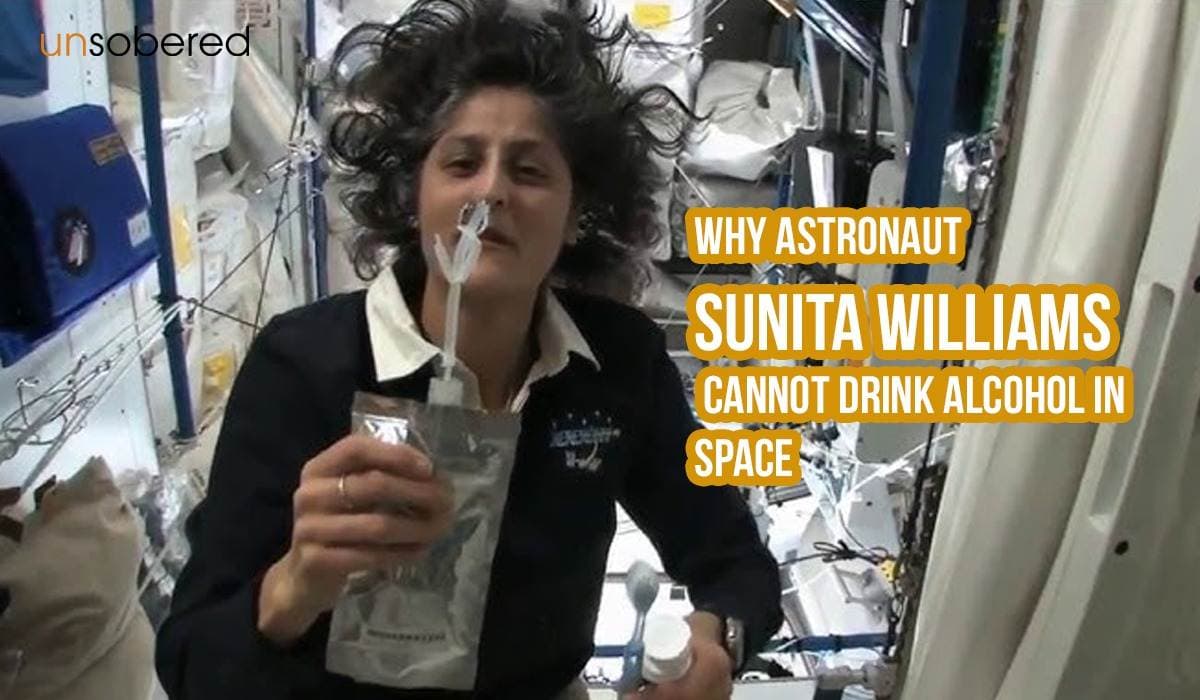
Sunita Williams’ legacy as an astronaut simply remains unparalleled! In her 27-year-long career in NASA (National Aeronautics and Space Administration), she has been part of some of the most important space missions in the history of humankind. In space, every action counts and every mistake can severely backfire. And this includes what astronauts can eat and drink. While alcohol may be a casual indulgence on Earth, it has no place aboard a spacecraft. Why so? And do astronauts like Sunita Williams even consume alcohol in space in the first place? Let’s take a deep dive into this topic.
NASA, in general, has prohibited astronauts from drinking in space as well as within 16 hours of a space launch. However, it has loosened its no-alcohol policy a few times. Reportedly, there was a plan to allow the Apollo 8 crew to drink a small ration of brandy to go with their Christmas meal, but Commander Frank Borman decided not to go ahead with the ‘brandy’ plan.
Alcohol is banned from space stations because of its chemical volatility. It has a tendency to vaporize and draw negative effects on the water recovery system in the space shuttle. It can act as a fire hazard and cause damage that would be too difficult to control in space. The ban is applicable not only to alcoholic beverages but also products containing the minutest traces of alcohol such as an aftershave or mouthwash.
Another reason why it is not allowed in space is because there is simply not enough scientific study on the effects of alcohol consumption on the human body in space. On Earth, i.e. in normal conditions, it can affect everything from the immune and nervous system to hand-eye coordination. So it cannot be assumed how alcohol can affect the human body in space without solid studies.
Born in 1965 to a Gujarati father and a Slovenian mother, Sunita Williams first launched aboard space shuttle Discovery with STS-116 in December 2006 and returned aboard Atlantis with the STS-117 crew. In 2012, she lifted off for a 127-day mission as part of Expedition 32/22 and went on to serve as space station commander for Expedition 33. Her most recent mission was in 2024-2025 being aboard Boeing Starliner and SpaceX Crew-9, where she commanded Expedition 72.
During her illustrious 27-year career, she not only spent 608 days in space, but also contributed to NASA on the ground as well, including handling operations in Russia, roles in astronaut training, and preparing astronauts for future Moon missions. She has also completed nine spacewalks, totaling 62 hours and 6 minutes. This is the most spacewalk time by a woman and ranks fourth on the all-cumulative spacewalk duration list. Williams is a retired U. S. Navy captain and has over 4,000 flight hours in helicopters and fixed-wing aircraft. After returning from her SpaceX mission, she has now announced retirement from NASA in January 2026.
Her achievements in the world of astronomy and space research continue to inspire millions of people around the world, especially young Indian minds who’ve grown up reading about her. She recently attended the inaugural evening of the Kerala Literature Festival on January 22, 2026. Here, she reflected on her inspiring journey and expressed her “FOMO (fear of missing out)” now that she has retired from service. Williams exclaimed that now she’s excited to see her “friends do this” and spend time “traveling all around”.
First designed in 2018, a specially designed champagne bottle – the Mumm Cordon Rouge Stellar – was tested aboard the International Space Station by the Axiom-4 crew in June 2025. The space certified bottle was made through a collaboration between Axiom Space and French champagne house Maison Mumm.
The bottle contains two chambers, one for the Champagne and the other for a valve that uses the carbon dioxide in the Champagne to eject foamy alcohol spheres. These can then be scooped into long-stemmed glasses for sipping. And once they’re inside the mouth, they turn back into champagne!
If you were wondering whether astronauts can drink in space – the answer is a firm “no” as of 2026. This is because alcohol is a volatile substance, can affect the cognitive and bodily functions of astronauts, and simply lacks enough data to support its consumption in space. With new advancements in technology, there is still a high chance that astronauts might be able to have a sip of alcohol in space.
.jpg&w=3840&q=100)