
.png&w=3840&q=75)
Whisky is one of the most consumed alcoholic spirits in the entire world, and India's relationship with whisky is also unusually large. The country is the world's biggest whisky market by volume, according to the Scotch Whisky Association, while Indian whisky itself has become an increasingly important category internationally. In 2025, India imported the equivalent of 220 million 70cl bottles of Scotch, making it Scotch's largest export market by volume.
Whisky is one of those drinks that can mean very different things depending on where you are drinking it. In India, it could mean a familiar bottle of Royal Stag or Blenders Pride or an Indian single malt from Amrut, Paul John, Rampur or Indri if you are feeling fancy. They all sit under the broad whisky category, but they are not made in the same way and certainly don't taste the same.
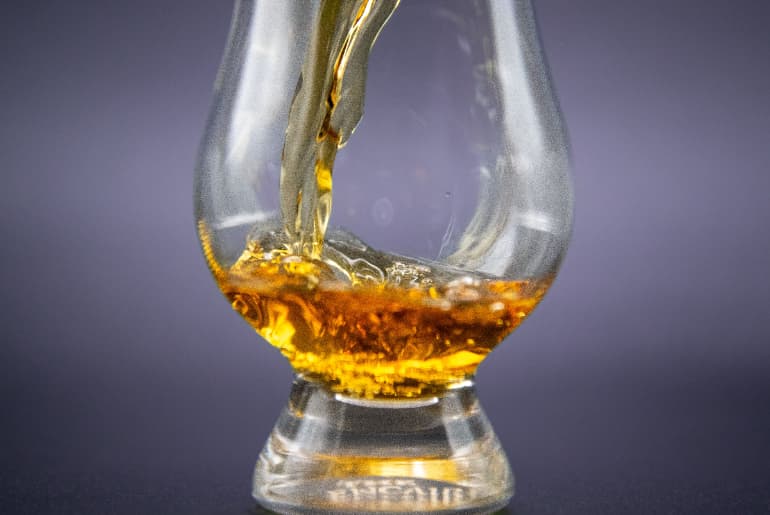
At its simplest, whisky is a distilled alcoholic spirit made from grains and matured in wooden casks, although the exact rules depend on the style and country where it is produced.
The grains can include barley, corn, rye or wheat. They are processed, fermented and distilled before the resulting spirit is generally matured in oak. That time in the cask is important because whisky picks up colour, aroma and flavor from the wood as it matures.
There is no single flavor that defines whisky. Some bottles are light and fruity, others are smoky and peaty, while some are rich with vanilla, caramel, dried fruit or spice.
And yes, the spelling matters too. Whisky is generally used for Scotch and Indian whisky, while whiskey is commonly used for American and Irish styles.
Also Read: 10 Best Indian Whisky Brands You Must Try
The numbers are difficult to ignore. Data from IWSR reported by TOI showed that Indian whisky volumes exceeded 130 million 9-litre cases during January to June 2025, growing 7% year on year. A 9-litre case is the industry's standard measure and represents twelve 750ml bottles.
India's enormous domestic market has also helped create some of the world's biggest whisky brands. In 2025, Royal Stag sold 32.6 million 9-litre cases, becoming the biggest-selling Indian whisky brand, according to The Spirits Business.
But something else is happening at the premium end. Indian single malts are no longer a niche curiosity. According to recent industry data reported by The Economic Times, India's single malt market reached roughly 5 lakh cases in 2025, with homegrown names including Amrut, Rampur, Indri and Paul John driving much of the growth.
Also Read: McDowell's No.1 Whisky Price In Kolkata: 180 ml, 375 ml and 750 ml
Most whisky you'll find on an Indian retail shelf falls somewhere around 40% to 46% ABV. The exact strength depends on the brand and style. Royal Stag, Blenders Pride and several mainstream Indian whiskies are generally around 42.8% ABV. Many Indian single malts, meanwhile, are bottled at 46%.
Some cask-strength whiskies can be considerably stronger because they are bottled closer to the strength at which they leave the cask. Those can easily cross 55% ABV.
So, a whisky's alcohol percentage doesn't automatically tell you whether it is good. It simply tells you how much alcohol is present. The character of the spirit comes from the ingredients, distillation, maturation and blending.
Indian blended whisky: This is the category most familiar to Indian consumers. These whiskies can combine different spirit components and are generally designed to be approachable and affordable.
Indian single malt: Made at a single distillery using malted barley, these are the bottles behind much of India's premium whisky story. Amrut, Paul John, Rampur and Indri are among the names worth knowing.
Scotch whisky: Imported Scotch ranges from blended Scotch to single malts and comes from Scotland. Johnnie Walker, Chivas Regal, Glenfiddich and The Glenlivet are widely available in India.
Bourbon: An American whiskey style made primarily from corn. Jack Daniel's and Jim Beam are familiar names, although Tennessee whiskey has its own classification and production traditions.
Irish whiskey: Generally known for its softer, approachable style, with Jameson being one of the most widely available examples in India.
Prices vary substantially between states because alcohol taxation and retail rules are controlled at the state level. So these should be treated as broad 2026 ranges, not fixed national MRPs.
Also Read: Royal Stag Becomes World's No. 1 Whisky Brand, Sells 32.6 Million Cases in 2025
Royal Stag: around INR 500–800 for 750ml
Blenders Pride: around INR 950–1,400
Antiquity Blue: around INR 1,150–1,750
Johnnie Walker Black Label: around INR 3,200–4,500
Chivas Regal 12: around INR 3,800–8,500
Amrut Fusion: around INR 3,200–7,500
Paul John Brilliance: around INR 3,000–7,000
Indri Single Malt: around INR 3,000–5,900
Rampur Asava: around INR 4,500–8,500
These ranges reflect differences between states, bottle sizes and retail channels, so checking the local price before publishing a buying guide is important.
For decades, whisky in India was largely associated with large-volume blends and imported Scotch. That picture is changing.
Indian distilleries are now producing single malts that have built serious international followings, while consumers are increasingly willing to spend more on bottles with distinctive production methods and regional character. The growth of Indri, Amrut, Paul John and Rampur is part of that shift.
At the same time, the mainstream market remains enormous. That's what makes India unusual: the country has a huge value-driven whisky market sitting alongside a rapidly developing premium and luxury segment.
And that may be the most interesting thing about Indian whisky today. It isn't replacing one style with another. It is making room for all of them.
.jpg&w=3840&q=100)
.jpg&w=3840&q=100)
.jpg&w=3840&q=100)