

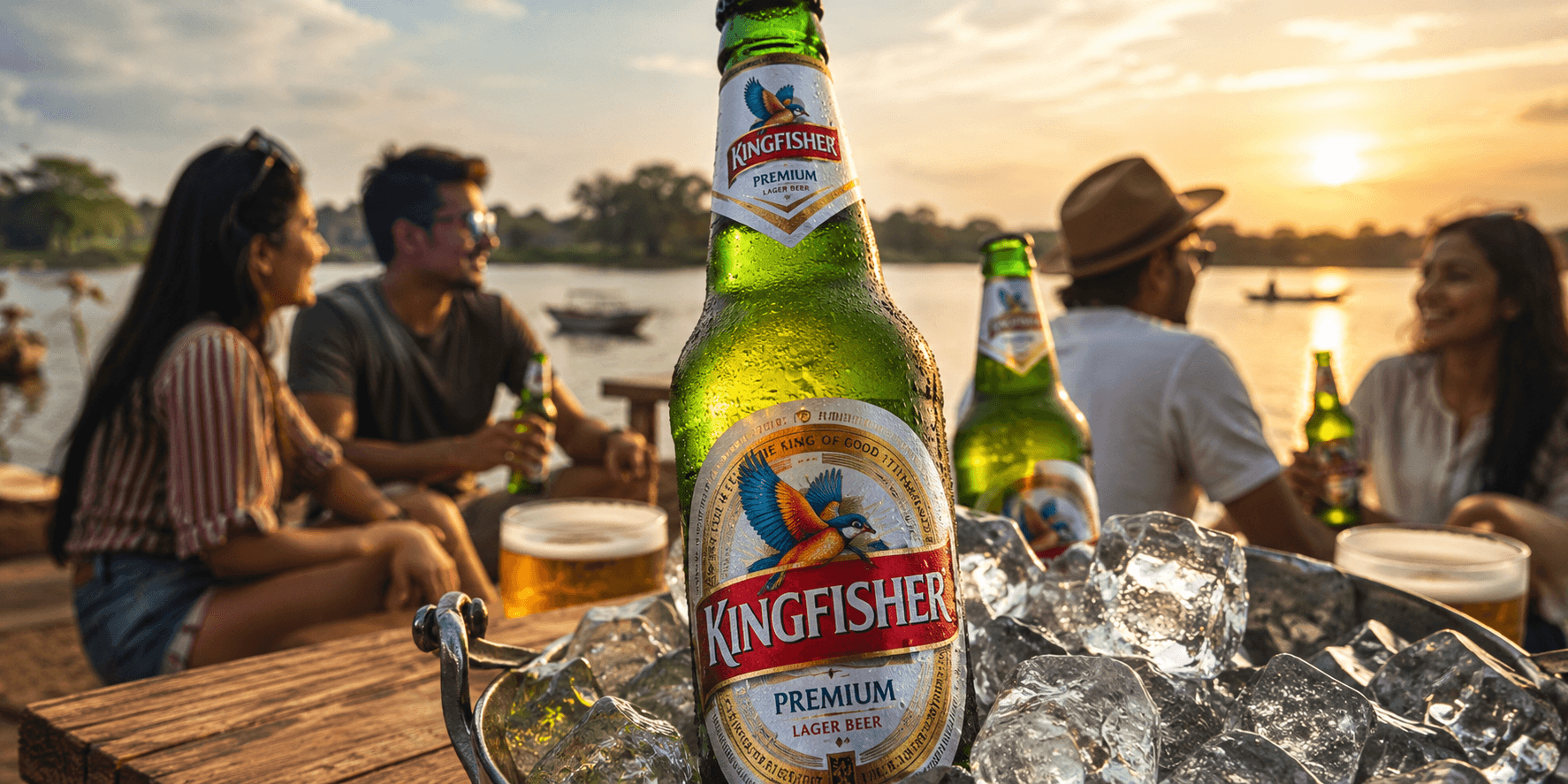
In India, when someone says beer, there is a pretty good chance Kingfisher is one of the first names that comes to mind. Not Corona, not Budweiser, but Kingfisher. For generations of Indian drinkers, the red-and-white Kingfisher logo has been almost impossible to miss. It has been at college parties, cricket matches, beach holidays, weddings, nightclubs and those random evenings when someone says, “Let's just have one beer,” and somehow that one becomes three.
The brand also became closely linked with Vijay Mallya and his famous “King of Good Times” image. But the story of Kingfisher beer is actually much bigger than Mallya himself. It is a story about branding, changing Indian drinking habits, aggressive expansion and, eventually, a business empire that became far more complicated than beer.
The Kingfisher story sits inside United Breweries, a company with roots going back well before Vijay Mallya became its most recognizable face.
Kingfisher was relaunched as a beer brand in 1978, and over time United Breweries turned it into its flagship name. The idea was fairly straightforward: make beer feel younger, more modern and more aspirational in a country where beer was still nowhere near as culturally big as it is today.
Also Read: Kingfisher Beer: Complete Guide, Prices, Variants & Alcohol Percentage
Kingfisher wasn't trying to look like some serious European beer. It was colorful, loud and easy to recognize. The name itself helped. A kingfisher is a bright, striking bird, and the brand built a visual identity around it that was hard to forget.
Vijay Mallya became chairman of United Breweries after the death of his father Vittal Mallya in 1983. United Breweries' own historical records identify Mallya as chairman during the period when the company was rapidly expanding its beer business.
This is where Kingfisher became more than just a beer. Mallya understood something that many Indian alcohol companies were still figuring out: people don't only buy the liquid in the bottle. They buy the feeling around it.
Kingfisher was pushed into nightlife, entertainment, sport and lifestyle. The brand became associated with parties and young people having a good time. The famous “King of Good Times” image fit perfectly into that world. And honestly, it was very clever marketing.
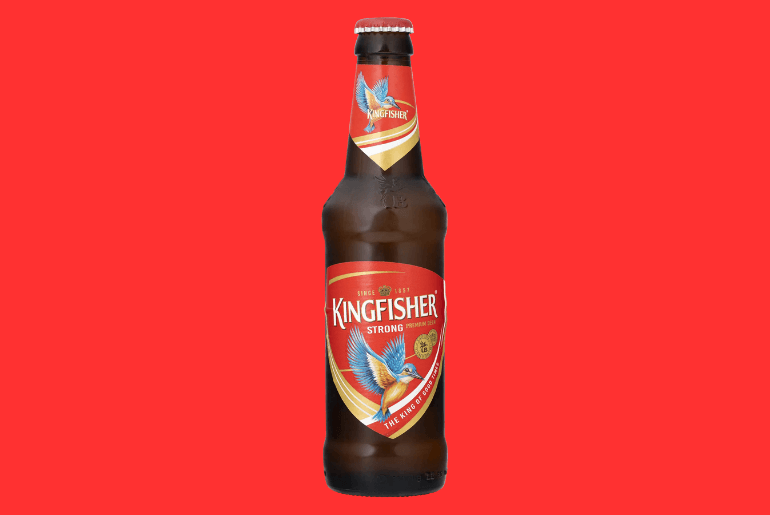
By the 1990s and early 2000s, Kingfisher had become almost synonymous with beer in India. There were different versions for different drinkers, but the biggest move was the growth of Kingfisher Strong. India was developing a strong preference for stronger beer, and Kingfisher was in exactly the right place to take advantage of it.
The company kept expanding its reach and manufacturing footprint, while Kingfisher's advertising and sponsorships kept the brand visible.
Cricket played a huge role too. So did fashion, music, nightlife and the general Mallya lifestyle and the result was enormous.
United Breweries' 2012 annual report recorded a landmark 100 million cases of Kingfisher beer sold, calling it the “crowning highlight” of the company's growth story.
The Kingfisher name expanded beyond beer when Mallya launched Kingfisher Airlines in 2005. The airline was positioned as a premium, stylish carrier and, initially, it attracted a lot of attention.
But unlike beer, airlines are a brutally expensive business. Kingfisher Airlines struggled with debt, costs and operational problems. Eventually, the airline stopped flying in 2012.
The collapse damaged Mallya's reputation badly, and his wider business empire came under enormous financial and legal pressure. It is important, though, not to mix up the two stories. Kingfisher beer did not disappear when Kingfisher Airlines collapsed.
Also Read: Which Kingfisher Beer Is Best For Beginners?
This is probably the most interesting part of the whole story. Vijay Mallya's personal association with United Breweries weakened dramatically over the following years. He eventually lost his formal control of the company, while Heineken became the dominant shareholder in United Breweries.
United Breweries' latest corporate material still describes Kingfisher as its iconic flagship brand and says the brand is synonymous with beer in India. The company's current business is also much more closely connected to Heineken than to the old Mallya-era UB Group.
And that is why calling Kingfisher a fallen beer brand would actually be misleading. Mallya's business empire went through a spectacular fall. Kingfisher beer didn't.
Also Read: Beer Brands You Can Only Find In Goa
There isn't some official title or global beer organization that crowned Kingfisher the “King of Beers.” It is more of a reputation built over decades. The reason the name stuck is simple: Kingfisher became one of the beers that defined drinking in modern India.
It had the distribution, the advertising, the recognition and the cultural presence. Even people who don't drink beer often know the Kingfisher logo.
And the brand has continued to evolve. United Breweries still sells several Kingfisher variants, while also operating major international brands such as Heineken and Amstel in India.
So, when people call Kingfisher the “King of Beers”, they aren't necessarily talking about whether it is technically the best-tasting beer in the world. They are talking about influence, the reputation and overall recall value it left. For a huge number of Indian drinkers, Kingfisher was the beer that made beer feel like a lifestyle.
Also Read: Budweiser Beer: Complete Guide, Prices, Variants & Reviews (2026)
Personally, I think that's what makes the Kingfisher story more interesting than a simple “beer brand became successful” story. The beer survived one of the biggest business collapses associated with its owner and somehow remained part of India's drinking culture.
Vijay Mallya may no longer be the face of United Breweries, but the Kingfisher bottle is still sitting behind bars across India. But Kingfisher beer did something in India that no other alcohol brand could do.
.jpg&w=3840&q=100)
.jpg&w=3840&q=100)
.jpg&w=3840&q=100)