
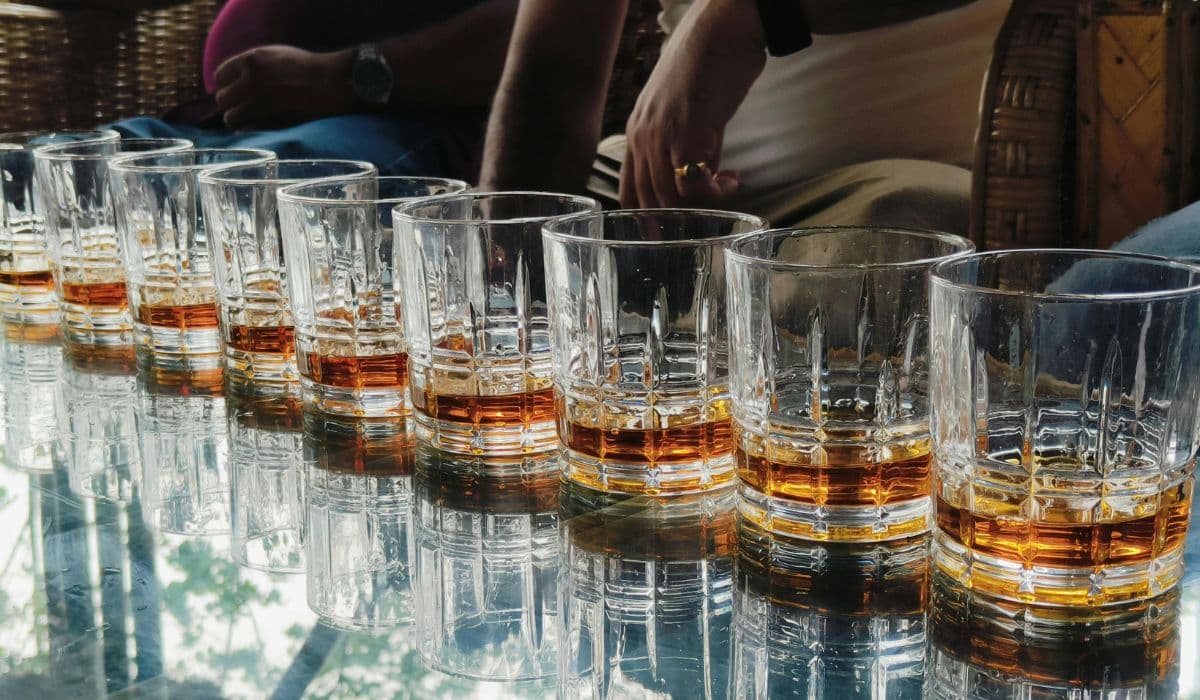
Did you know that India is the biggest consumer of whisky in the world by volume? This fact makes it all the more jarring that buying an authentic bottle of imported Single Malt or Blended Scotch in Indian cities such as Mumbai, Delhi, or Bengaluru will cost you significantly more than it would in foreign cities such as Dubai, London, or New York. This high pricing is not because of distillery markups, but rather because of a compounding layer of Union Government customs tariffs, state-level excise duties, logistics costs, and distribution markups. In this unsobered guide, we take a look at how taxes, regional excise variations, licensing fees, and logistics combine to make Scotch whisky a premium luxury purchase in India.
India has had an aggressive 150 percent import tariff on all foreign-made spirits for decades. This was primarily done in order to protect domestic grain whisky distilleries and generate federal revenue. Recently, however, many things have changed, especially since India signed the free trade agreement with the UK.
.jpg&w=1920&q=75)
The India-UK Free Trade Agreement (CETA) reduced the basic tariff on British-origin spirits from 150 percent down to just 75 percent. This tariff consists of 25 percent Basic Customs Duty and 50 percent Agriculture Infrastructure and Development Cess.
Now, to those unlettered in Indian state excise policies, this might sound incredibly encouraging. However, there is still a catch. Despite this landmark cut, the final retail shelf prices have only softened by 10 percent to 15 percent, and that too in select states. The reason? The federal customs duties, which are only the first layer of taxation.
Now this is important to understand. Alcohol taxation, as per the Constitution of India, is governed entirely by individual state governments rather than the central government. The states impose levies that are layered in nature. These include the State Excise Duty, Additional Excise Duty, Import Pass Fees, Brand Label Registration Fees, and Value Added Tax (VAT).
Since each state is free to determine its own rate of taxation, alcohol prices can vary depending on the region you’re in. States like Maharashtra and Karnataka are considered high-tax regions, as the excise duties imposed here can add up to 40 percent to 60 percent to the final price of the bottle, and this is on top of the imported CIF value.
Whereas regions like Gurgaon in Haryana are considered low-tax regions. These states have low excise slabs and flat import fees, which makes the exact same bottle of Johnnie Walker Black Label or Glenfiddich 12 significantly cheaper in Gurgaon than in Mumbai.
Also Read: Ladyburn 58-Year-Old Scotch: The Story Behind The $301,624 Whisky
.jpg&w=1920&q=75)
Whether a spirit is bottled in origin or bottled in India can also make a significant difference in price. Spirits bottled in India are significantly cheaper than the ones bottled in origin. This is mostly for understandable reasons. Properly bottled liquor is harder to transport and will fetch a heftier price. Logistics for spirits bottled in India, however, are much easier to figure out. The following part lays out the difference between the two quite explicitly:
Bottled In Origin: Scotch whisky that has been bottled in origin means that the entire process, right from distillation, aging, and bottling, all of it is entirely done in Scotland. Scotch brands such as Macallan, Talisker, and Glenlivet are perfect examples.
Such bottles are also subjected to the highest amounts of customs tariffs, high state registration fees, and premium glass freight costs.
Bottled In India: Spirits bottled in India, on the other hand, are imported at lower customs rates in large vats. The spirit is imported in high-proof bulk, and they are then bottled in India. This means that heavy bottled packaging tariffs are easily avoided, thereby offering a significantly lower retail price to consumers. Brands like Teacher's, Black and White, and 100 Pipers are all examples of Scotch that has been bottled and aged in India.
Also Read: Scotch Whisky To Become Cheaper In Delhi? Excise Dept Mulls Reduced Custom Duty
So, now you know why your dram is so pricey. There is a legitimate structural stack of central tariffs, state excise duties, annual brand registration fees, and retail VAT that make Scotch whisky so expensive in India. But things are not as bleak as they seem. Recent trade agreements are gradually lowering customs tariffs. However, it is important to note that state-level excise policies remain the defining factor in how much you pay at your local liquor store.