
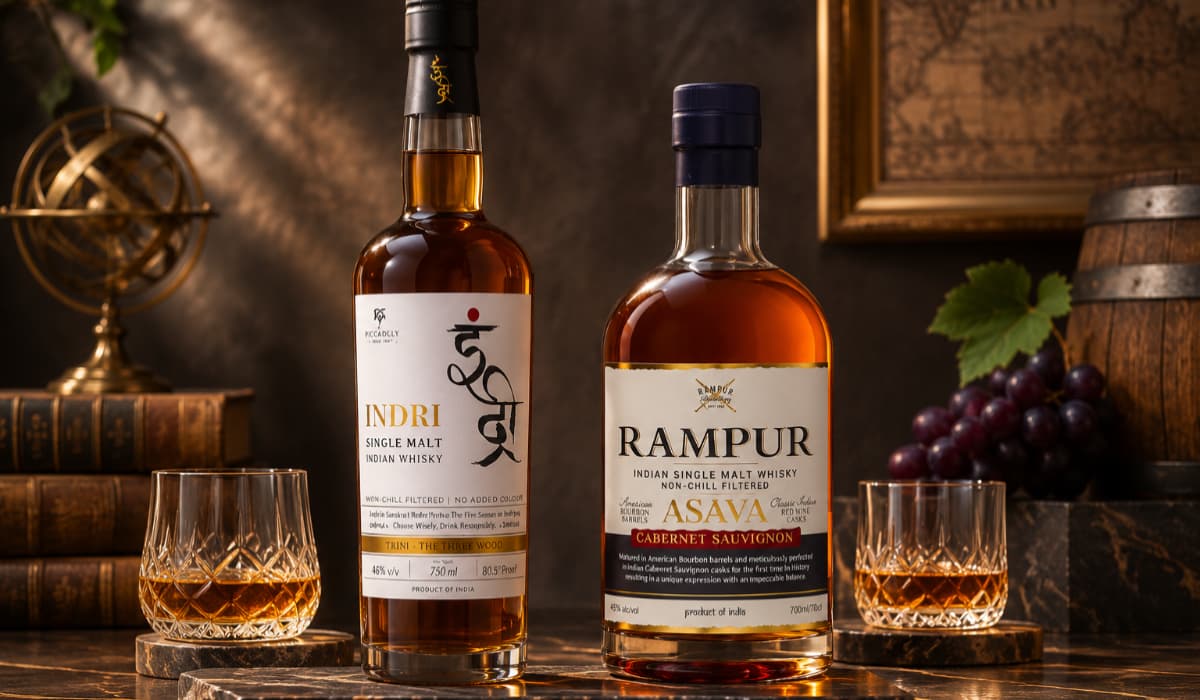
Indian single malt has come a long way in terms of international recognition and is now a fairly well established category. The distilleries have been experimenting with a range of different maturation techniques, cask types and local flavor profiles. Two of the expressions that really highlight this are the Indri Trini and the Rampur Asava which are both Indian single malts using oak casks in very different ways.
While Indri Trini brings the whiskies together in three different casks, Rampur Asava finishes its bourbon matured spirit in Indian Cabernet Sauvignon wine casks. The result is that both are very much cask driven in terms of their aroma, flavor and texture. They're both very good examples of how the cask you finish in can have a huge impact on the final product.
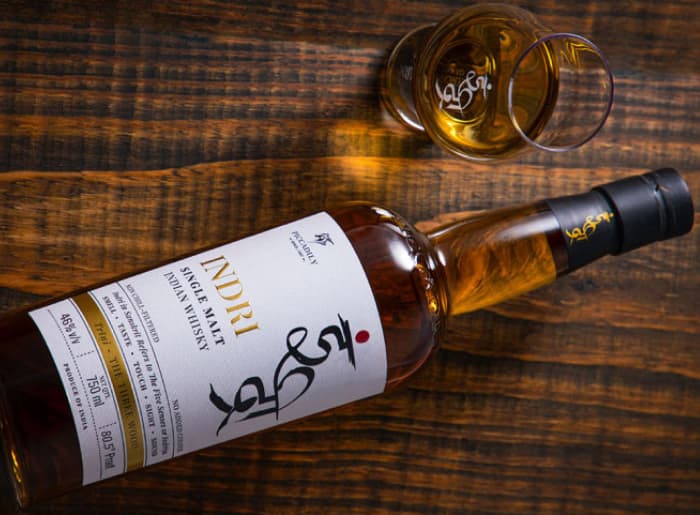
Made by Piccadily Distilleries in Haryana, Indri Trini is an Indian single malt whisky launched in 2021. The 'Trini' in the name refers to the three types of casks the whisky is matured in. It's also known as The Three Wood as it is a mixture of malt matured in ex-bourbon, ex-French red wine and Pedro Ximénez (PX) sherry casks.
Each cask imparts different characteristics to the final whisky. Ex-bourbon barrels are linked to vanilla and coconut, French red wine casks to honey and pepper, PX sherry casks to a greater sweetness and dark fruit. The variously matured whiskies are then blended together to create the final Indri Trini.
As per Indri's official tasting notes the whisky has the aromas and flavors of caramelized pineapple, black tea, raisins, citrus and a touch of nutty flavor. The triple cask approach means that a number of the wood characteristics are present without depending on a single finishing cask.
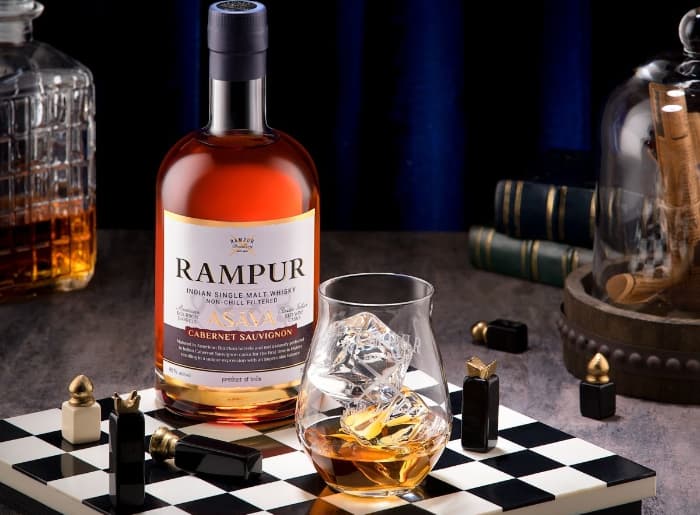
Rampur Asava, made by Radico Khaitan at its Rampur distillery in UP has a different maturation profile. It is initially matured in American bourbon casks and then further matured in Indian Cabernet Sauvignon wine casks. It is not a mixture of whisky from three different cask types.
The bourbon barrels give the spirit its fundamental character with the typical American oak notes of vanilla and sweetness. The Indian red wine casks then add another dimension of flavor, providing quite distinct notes of dark fruit, spice and a certain dryness.
Rampur's official tasting notes speak of apricot, blackberry, plum, tobacco and spice on the nose with the palate delivering manuka honey, spicy oak, vanilla and the dryness of the wine cask finish. Radico Khaitan refers to Asava as the world's first whisky to be finished in Indian red wine casks, noting the application of locally sourced wine casks.
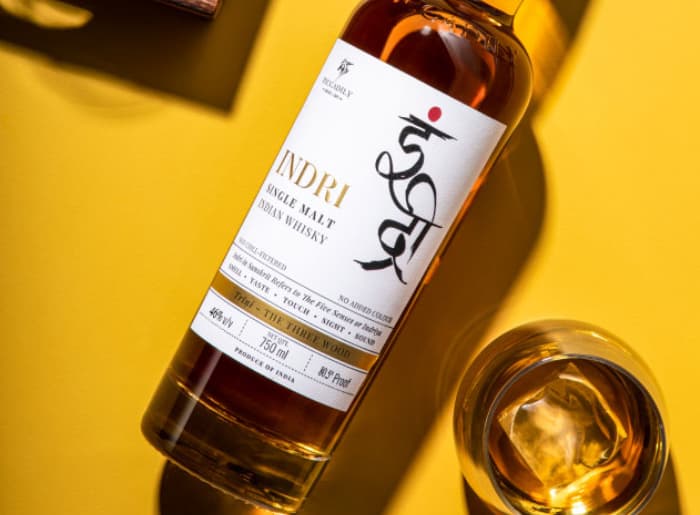
The most obvious difference between Indri Trini and Rampur Asava is in the way the casks have affected the final product. Indri Trini is a mixture of three different maturation styles which gives it a profile that is a combination of sweetness, fruit, spice and oak. The bourbon, French wine and PX sherry have all contributed different characteristics which are then blended together.
Rampur Asava places much more emphasis on the bourbon maturation and the red wine finishing. The bourbon maturation gives you a base of vanilla and oak, the Cabernet Sauvignon casks then bring in the dark fruit and a drier finish. It's very much a berry, honey, spices and wine oak profile.
For the drinker who likes a bit of layering in the sweetness, some of the caramelized fruit and the sherry notes, Indri Trini is a very interesting proposition. Rampur Asava might be of interest to those who like the darker fruit and the Indian red wine cask influence. All of these are based on the producers' own tasting notes and individual experiences will of course vary.
Ever wondered how Indri and Amrut whisky differ? Explore the key differences in their production, maturation, and taste profiles.
Cask selection is of course one factor in the finished spirit, but both Indri and Rampur operate in northern India where the annual temperature swings have a significant impact on how the whisky matures in the oak casks.
During the warmer periods the temp of the spirit will interact with the wood in a different way. In the cooler periods it's a different interaction. Over time the temperature will have an effect on the character of the spirit, as will the history of the cask, the type of wood and the length of maturation.
Indri's producer points to the hot summers and cold winters of the region as a major influence on maturation. Rampur is in much the same climatic bracket. The flavor of neither whisky however can be said to be down to climate alone. It's the combination of the maturation conditions and the casks that are used which is key to the finished expressions.
Curious about India's top-ranked single malts? Discover the ranking that places Indri first and Godawan second, and see which other whiskies made the list.
This is all drawn from official Indri and Rampur Single Malt information, Radico Khaitan's Feb 2026 investor presentation and the 2024-25 annual report. It covers the production, maturation, tasting notes, brand history and range of the whiskies.
Indri Trini and Rampur Asava are both examples of different approaches to cask maturation in the developing Indian single malt whisky sector. Indri Trini uses a combination of ex-bourbon, ex-French red wine and PX sherry casks to mature its whisky.
Rampur Asava takes a more sequential approach, starting with bourbon barrel maturation and then introducing the influence of Indian Cabernet Sauvignon casks. Both expressions use wine casks but the way those casks have impacted the final whisky is very different. Ultimately, the comparison is about Indian whisky producers experimenting with maturation to create distinctive single malts, using cask selection to shape the aroma, sweetness, fruit character, and finish.